
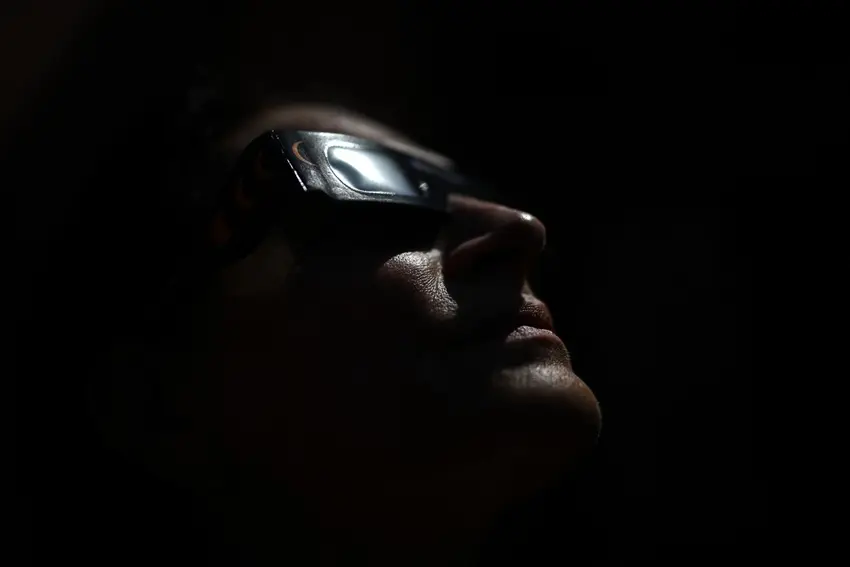
Looking at the sun during the August 12th total solar eclipse without proper protection can cause permanent retinal damage and even blindness, as infrared and ultraviolet radiation can burn the eye painlessly and without warning.
Spain’s Scientific and Advisory Commission for the Trio of Eclipses, the government-appointed body responsible for managing these events, has warned that viewing should only be done with specific eclipse glasses that meet safety requirements.
This comes after six protective glasses sold in Spain were recalled just two days before the August 12th eclipse.
Sunglasses suitable for viewing the sun must bear the EN ISO 12312-2:2015 mark, a valid CE marking if sold in the European Union, and display the manufacturer's name, instructions for use, and warnings.
If only the ISO 12312-1 reference is shown, they are not suitable for direct sunlight observation, as they may simply be ordinary sunglasses for general use.
Spain’s eclipse commission, created by the National Astronomy Commission (CNA), specified in a report that improvised filters and optical instruments without adequate protection should not be used either.
It also warns that the danger increases with binoculars, cameras, regular eyeglasses, and telescopes, as their lenses concentrate light like a magnifying glass does.
How to tell if your eclipse glasses are certified
The first thing to check is the technical reference. As mentioned earlier, the international standard EN ISO 12312-2:2015 sets the conditions for sunglasses designed for looking directly at the sun must meet.

This standard requires that the filter allow a maximum of 0.0032 percent of visible light and a minimum of 0.000061 percent to pass through.
It also mandates effective blocking of ultraviolet radiation and limits the amount of infrared radiation that passes through the material. This ensures eye protection.
READ ALSO: Q&A - Everything you need to prepare for the total solar eclipse in Spain
If the product is sold in the European Union and is certified, the CE marking must be visible, legible, and indelible.
According to Regulation (EU) 2016/425 on personal protective equipment, this mark is only valid if it is supported by laboratory tests that demonstrate compliance with the ISO standard. This ensures that the glasses are safe.
In addition to marking, the labelling must include the manufacturer's name, clear storage instructions, warnings about the dangers of looking at the sun without protection, and, where applicable, the expiration date.
How to tell if eclipse glasses are safe
Spain’s eclipse commission explains that the filter must have uniform light transmission across its entire surface and cannot have scratches, bubbles, stains, or lighter areas.
It’s not recommended either to use glasses with loose, bent, or damaged filters (lenses).
A single weak point can allow enough light to pass through to damage eyesight.
The mounting is also part of the requirements. The lenses must cover both eyes equally, be free of sharp edges or irritating materials, and securely hold the filter, whether mounted like regular glasses or presented on a cardboard backing sheet.
Why did Spain withdraw six eclipse glasses models from the market?
The withdrawn glasses correspond to the brands Lionstar , ECP Eye Care Professional, Pelispan, Homanaje, Orro and Opticalia.
Spain’s Ministry of Consumer Affairs decided to recall them not because they've detected irregularities in the materials, surfaces or frames, but rather because they're so dark that that they could encourage the users to tilt them to get a better view of the total solar eclipse, and potentially damage their retinas in the process.
READ MORE: The six models of solar eclipse glasses recalled in Spain
Comments